How Email Verification Works: The MillionVerifier Process
What You’ll Learn
- What deep-level email verification really means
- Why regex and simple syntax checks are not enough
- How MillionVerifier verifies every email step by step
- What happens during the SMTP handshake
- How greylisting is resolved automatically
- Why Smart Verify improves accuracy on hard-to-classify emails
- How the same engine supports both bulk uploads and real-time API use
- Why MillionVerifier backs its results with a 100% money-back guarantee
Email verification is easy to misunderstand because many people assume an address is valid if it simply looks correct. In reality, a properly formatted email address can still bounce, belong to a disposable inbox, point to a dead domain, or sit behind a strict mail server that weak tools cannot interpret.
MillionVerifier was built to solve that problem at a deeper level.
This guide explains exactly how the MillionVerifier process works behind the scenes, from basic syntax cleanup to deep SMTP-level checks, greylisting resolution, and Smart Verify accuracy enhancements. If you want to understand how professional email verification actually protects sender reputation, campaign ROI, and deliverability, this is the process.
What Is Deep-Level Email Verification?
Deep-level email verification is the process of checking not only whether an email address is properly formatted, but whether the domain is live, the mail server is configured correctly, and the inbox can actually receive messages. Unlike simple syntax validation, deep-level verification uses DNS, MX record analysis, SMTP server checks, disposable email detection, role-account detection, and retry logic to determine whether an email is truly safe to send to.
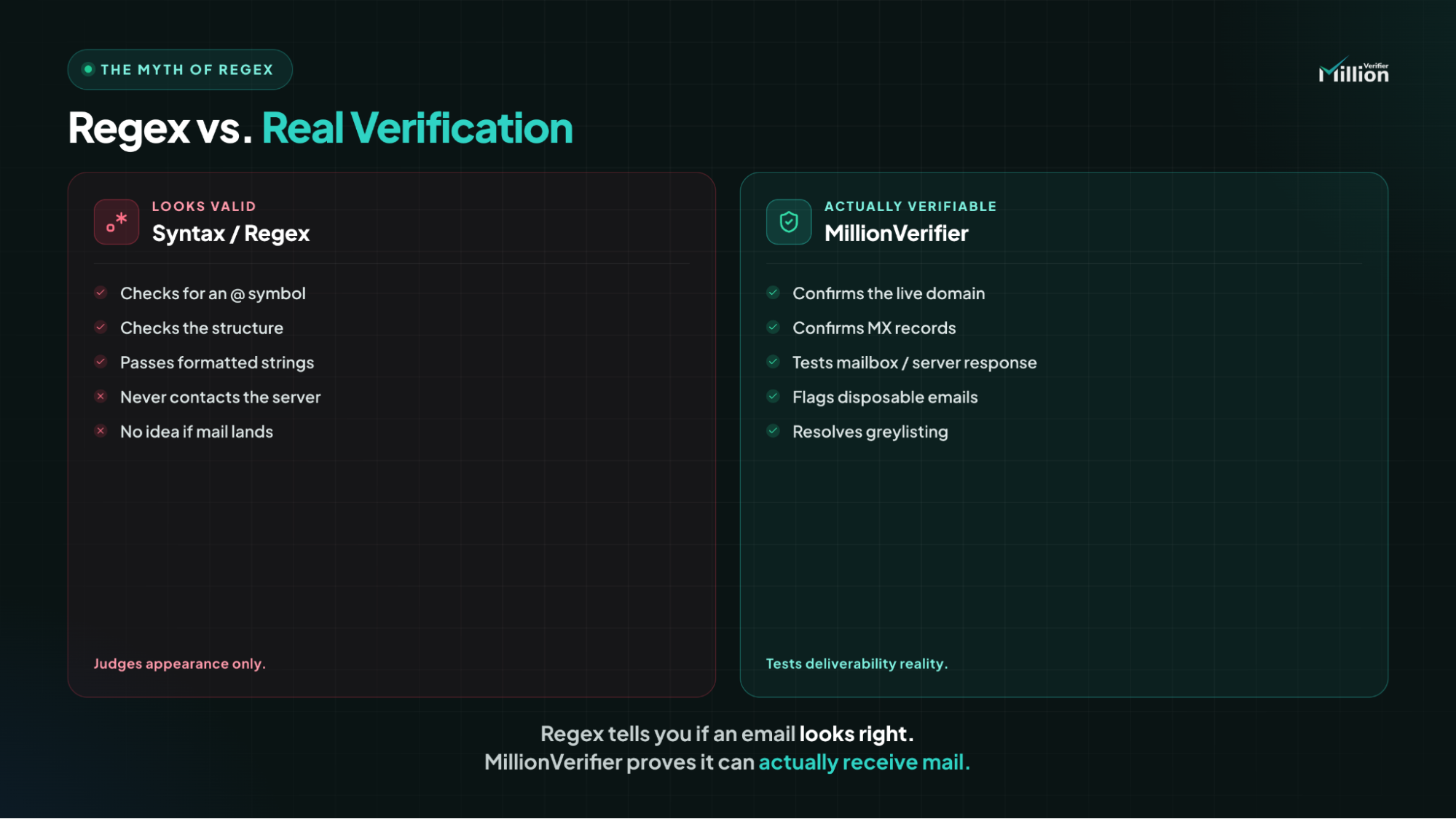
The Myth of Regex: Why Simple Syntax Checks Fail
A surprising number of developers still try to validate emails using regular expressions.
The logic seems reasonable at first glance: if an address contains an @ sign, a domain, and a valid-looking structure, it must be okay.
But that approach fails in real-world sending.
A regex check can only answer one question:
Does this email address look valid?
It cannot answer the questions that actually matter for deliverability:
- Does the inbox exist?
- Is the domain active?
- Does the domain accept mail?
- Is this a temporary disposable address?
- Is this a role-based inbox that may hurt outreach performance?
- Is the server temporarily rejecting verification attempts?
- Is the domain protected by catch-all behavior or strict firewall rules?
For example, an address like [email protected] may pass a regex test perfectly. But if the domain is inactive, the MX record is missing, or the receiving server rejects the user as nonexistent, that address is not sendable.
That is why syntax-only validation is dangerously inadequate.
A syntax check tells you whether an address looks right. Deep verification tells you whether the inbox is actually real and usable.
For businesses sending cold email, onboarding users, cleaning CRM databases, or protecting marketing deliverability, that difference is everything.
The 5-Step Verification Engine (Behind the Scenes)
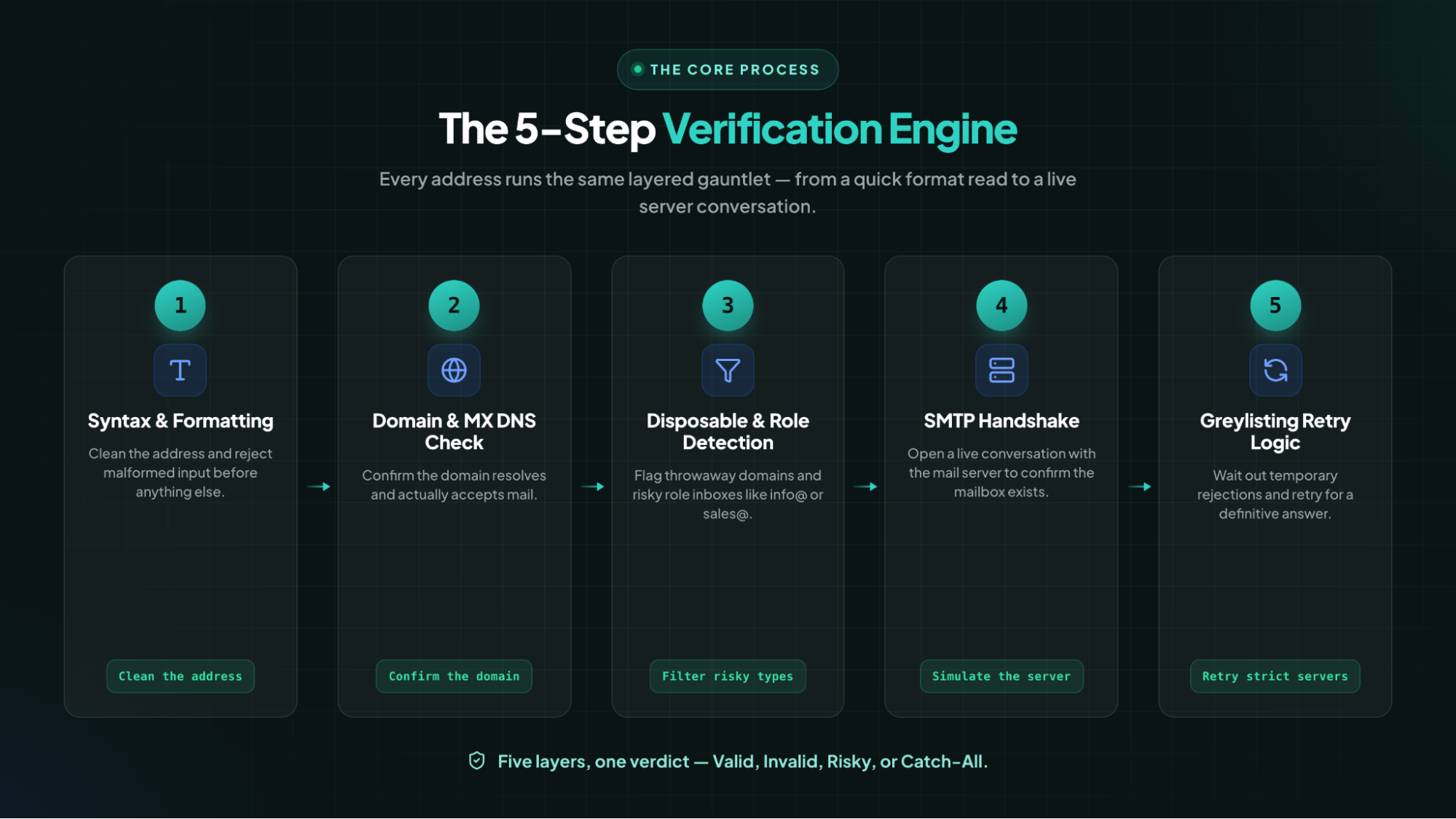
MillionVerifier processes every email through a chronological multi-layer verification workflow. This is what builds trust in the result. Instead of stopping at surface-level checks, the engine works through a full decision system to determine whether the email should be marked safe, risky, or invalid.
Here’s what happens behind the scenes.
Step 1: Syntax and Formatting Validation
This is the baseline layer.
Before deeper verification begins, MillionVerifier first checks whether the email address is structurally sound and normalized properly.
This includes:
- Removing accidental spaces
- Correcting common formatting inconsistencies
- Catching obvious fat-finger mistakes
- Ensuring the address follows recognized IETF-compliant formatting standards
- Identifying malformed local or domain parts
This step is important, but it is only the starting point.
A cleaned and properly formatted email still may not be deliverable. That is why the process immediately moves to domain and mail-server checks.
Step 2: Domain and MX Record DNS Checks
Once the email structure passes the first stage, MillionVerifier checks the domain itself.
This happens through DNS inspection.
The engine verifies:
- Whether the domain is active
- Whether the domain resolves correctly
- Whether valid MX (Mail Exchange) records are present
- Whether the domain is technically able to receive email
If the domain is dead, misconfigured, or missing valid MX records, the email is immediately marked Invalid.
This is a critical step because many bounced emails are not caused by bad usernames. They come from domains that simply cannot receive mail anymore.
A regex validator will completely miss this. MillionVerifier does not.
Step 3: Disposable & Role-Based Account Detection
Next, MillionVerifier checks whether the email belongs to a category that may be technically reachable but strategically low-value.
This includes two important types of addresses.
Disposable Email Addresses (DEAs)
Disposable email addresses are temporary inboxes created for short-term use, often through 10-minute mail providers or throwaway inbox services.
MillionVerifier checks the address against a continuously updated database of disposable email providers to identify these accounts before they pollute your list.
Why this matters:
- Disposable users are rarely long-term customers
- They distort conversion and engagement data
- They lower list quality
- They create noise in SaaS signups and lead capture funnels
Role-Based Emails
MillionVerifier also flags role-based accounts such as:
- admin@
- support@
- sales@
- info@
- contact@
These addresses are often real, but they can skew campaign results in cold outreach and B2B prospecting.
Why?
Because role-based inboxes:
- Are shared by multiple people
- Often produce lower reply rates
- Can trigger spam filtering more easily in some workflows
- Rarely behave like direct personal contacts in outbound campaigns
This step helps users separate technically valid emails from strategically ideal ones.
Step 4: The Invisible SMTP Handshake (Deep Pinging)
This is the core of deep-level verification.
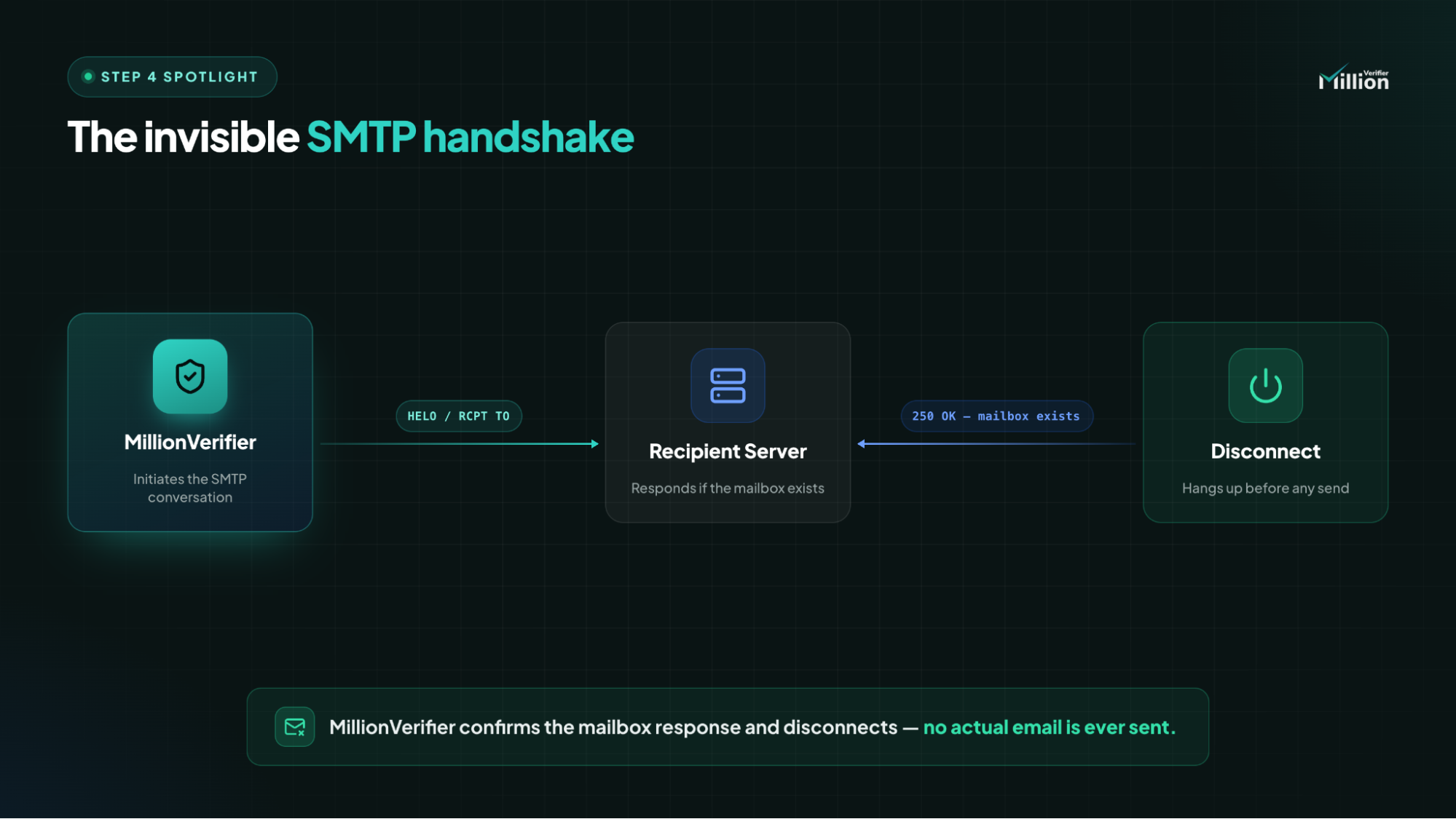
At this stage, MillionVerifier’s servers connect directly to the recipient’s mail server, whether it is run by Google, Microsoft, Yahoo, or a private business mail infrastructure.
The goal is to simulate the beginning of a real email delivery attempt without actually sending an email.
In simple terms, the process works like this:
- MillionVerifier opens a connection to the recipient mail server
- It starts the SMTP conversation exactly as a real sender would
- The receiving server is asked whether the specific mailbox exists
- If the server confirms the recipient is valid, MillionVerifier records that signal
- The connection is then dropped before any actual message content is transmitted
No email is delivered to the target inbox. No message is seen by the recipient. No actual send occurs.
This “deep pinging” approach is what allows MillionVerifier to move beyond guesswork and check real mailbox existence directly at the server level.
This is also the point where weaker verification tools start to fail. Many tools stop too early, rely on shallow heuristics, or return uncertain classifications. MillionVerifier continues deeper.
Step 5: Advanced Greylisting Resolution
Some mail servers are intentionally strict.
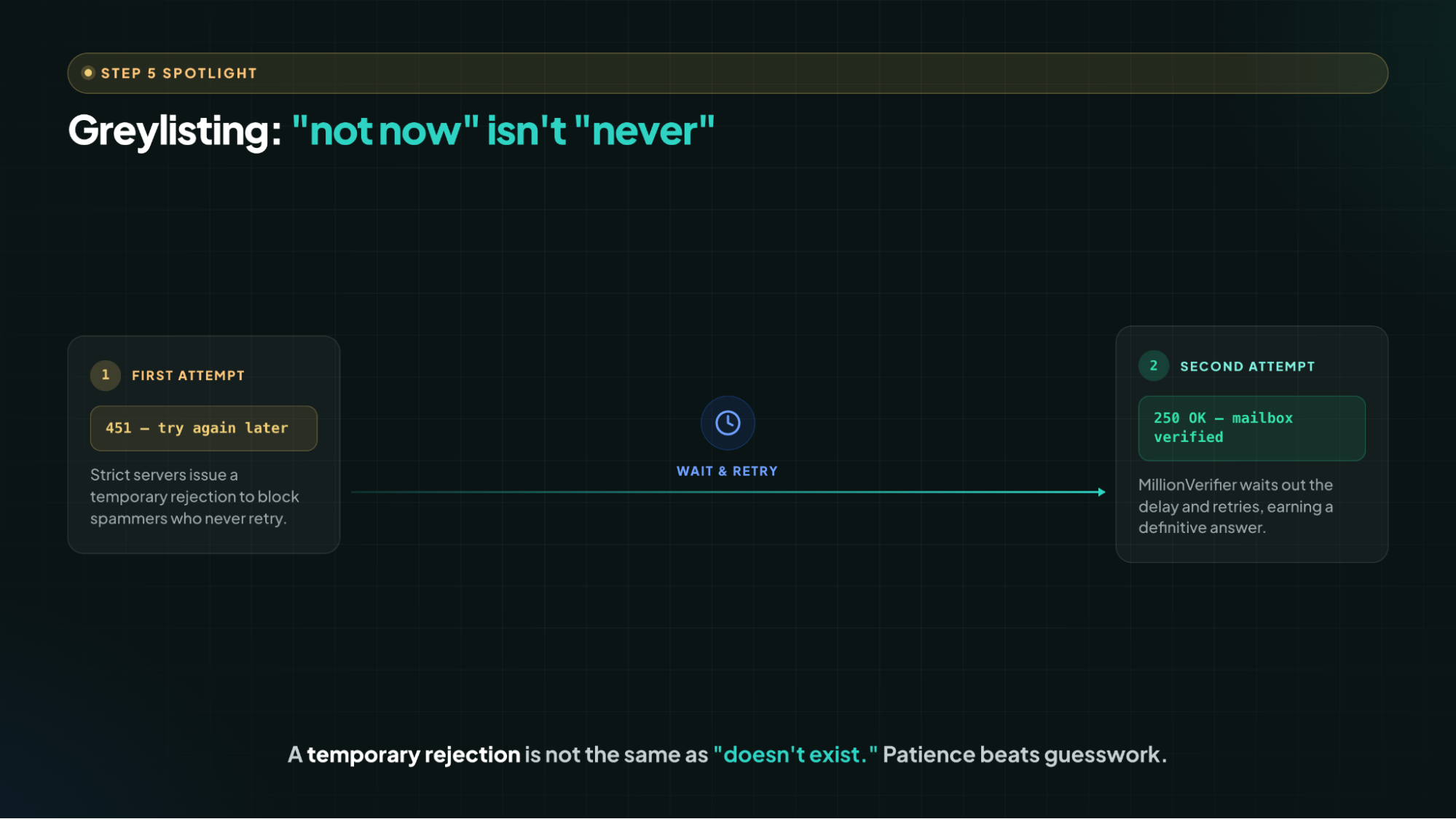
Instead of giving a clear answer immediately, they temporarily reject requests from unknown IP addresses or unfamiliar senders. This behavior is known as greylisting.
Greylisting is not a permanent rejection. It is a delay tactic.
The server is essentially saying:
“Come back later, and I may give you a proper answer.”
Many verification systems mishandle this moment. They either:
- Give up too quickly
- Return an inconclusive status
- Mark the result as Unknown by default
MillionVerifier handles it differently.
Its engine automatically:
- Detects greylisting behavior
- Pauses the verification attempt
- Waits the appropriate amount of time
- Retries the connection in the background
- Continues until it gets a more definitive response whenever possible
This retry logic is a major reason why MillionVerifier can produce stronger, more usable results than tools that stop at the first temporary roadblock.
In plain English: if a strict server says “not now,” MillionVerifier does not assume “never.” It waits, retries, and works to get the real answer.
How “Smart Verify” Achieves 99%+ Accuracy
The five-step engine is the foundation, but MillionVerifier’s accuracy advantage goes further.
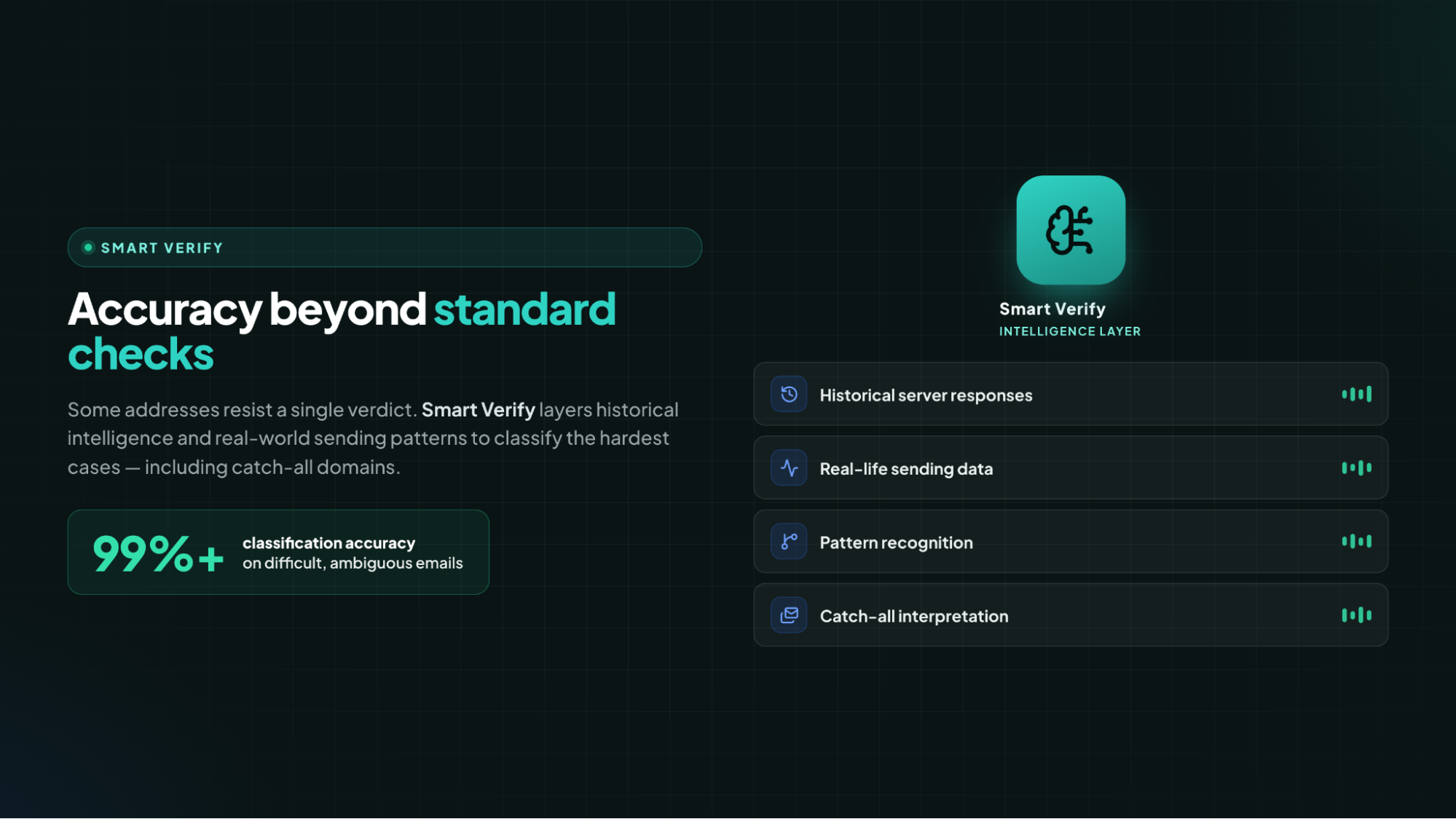
Smart Verify is the proprietary layer that helps classify emails that other tools struggle with, especially:
- Catch-all domains
- Strict corporate mail servers
- B2B environments with aggressive filtering rules
- Servers that produce ambiguous or inconsistent responses
Instead of relying only on a single live response, Smart Verify uses a broader intelligence model built from:
- Real-life sending data
- Historical server behavior
- Pattern recognition from past verification outcomes
- Response trends across similar environments
This matters because not every server behaves in a simple yes-or-no way.
Some domains accept all RCPT checks during SMTP and then silently bounce later. Others obscure mailbox-level truth behind security layers. Still others behave differently depending on timing, IP familiarity, or infrastructure policies.
Smart Verify helps MillionVerifier make better judgments in these edge cases.
That is how the platform pushes beyond generic verification logic and reaches 99%+ accuracy, particularly where lower-grade tools fall back to guesswork or overuse “Unknown” results.
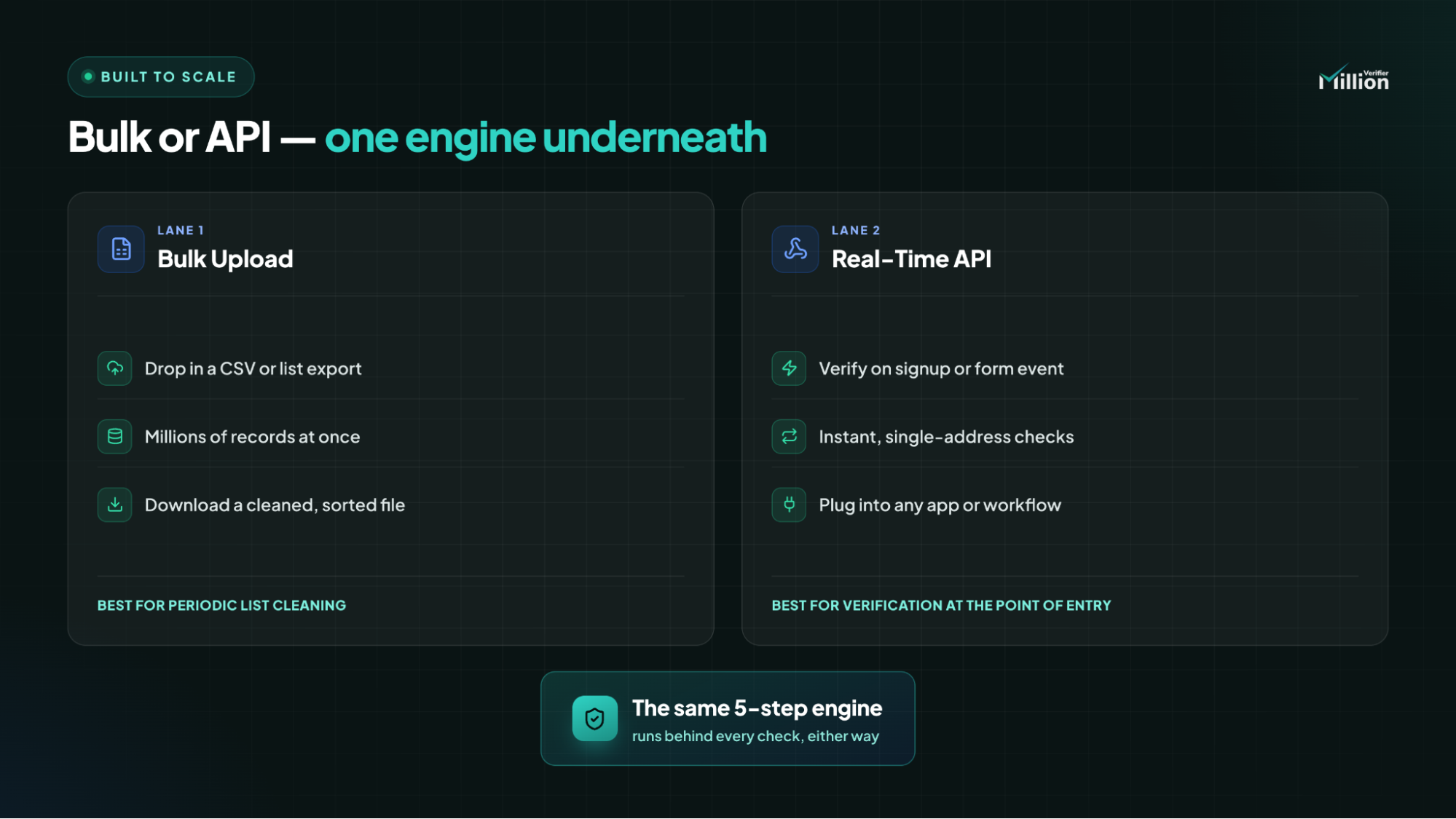
Bulk vs. API: How the Engine Adapts to Scale
Email verification needs are rarely one-size-fits-all.
Some users need to clean enormous databases before launching campaigns. Others need to verify addresses in real time inside signup forms, CRMs, lead capture flows, or product workflows.
MillionVerifier is designed for both.
For Bulk Verification
Lead generation teams, agencies, and data vendors can upload massive CSV files, including lists with millions of rows.
This is ideal for:
- List cleaning before cold outreach
- Database hygiene projects
- CRM maintenance
- Re-engagement campaigns
- Acquisition list preparation
For Real-Time API Verification
SaaS companies and high-volume platforms often need instant verification the moment a user submits an email.
This is ideal for:
- Signup forms
- Trial registration flows
- CRM enrichment pipelines
- Product onboarding systems
- Marketplace and platform user validation
Same Engine, Same Logic
The important reassurance is this:
Whether you upload a 2-million-row CSV or call the API hundreds of times per second, the same five-step verification engine is applied.
That means users get:
- The same deep SMTP-level logic
- The same DNS and MX checking
- The same disposable and role-based screening
- The same greylisting resolution methodology
- The same Smart Verify intelligence layer
In other words, scale does not mean reduced rigor. The process remains consistent, fast, and engineered for high-volume reliability.
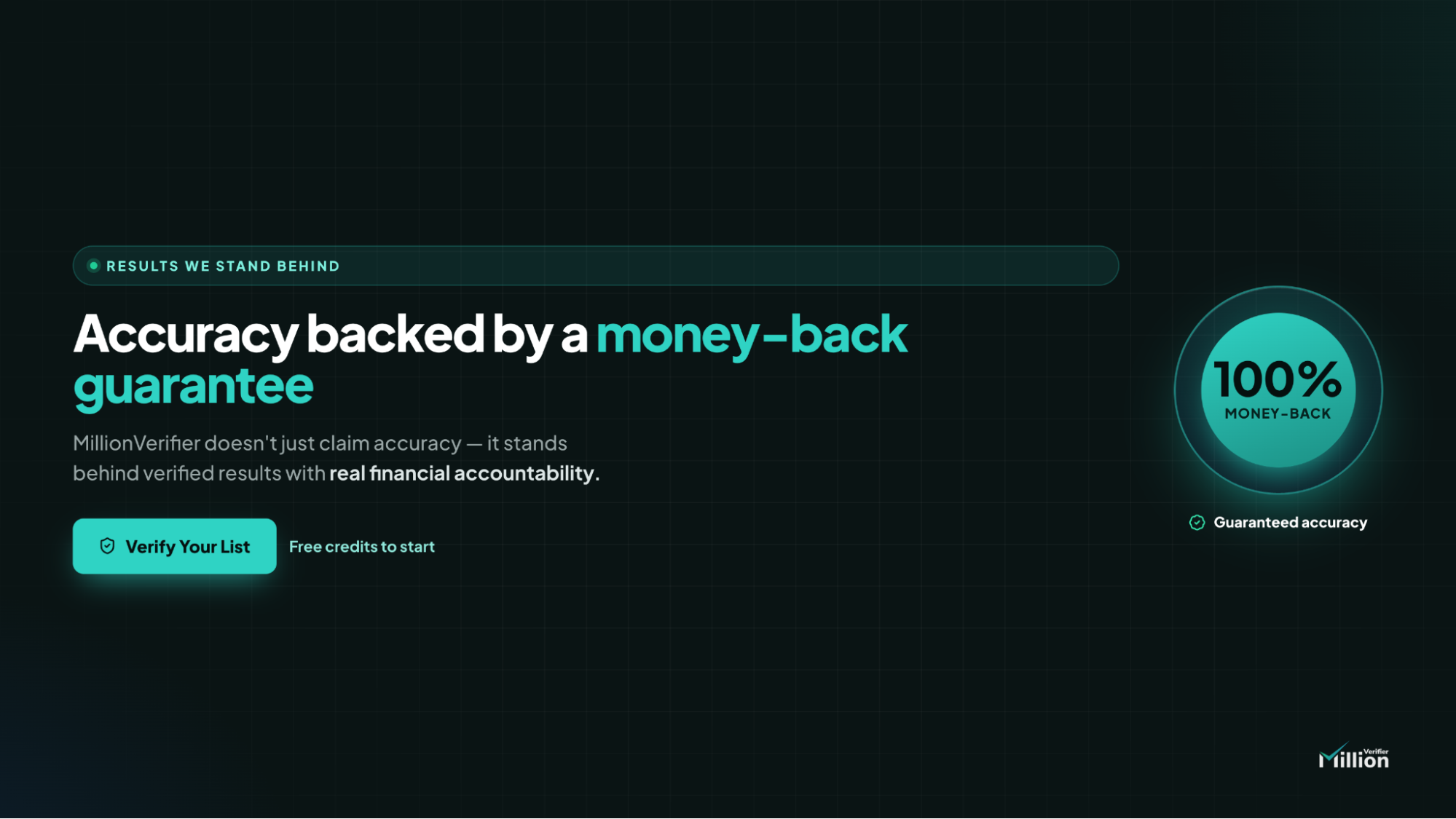
The 100% Money-Back Guarantee: Putting Our Engine on the Line
Most verification platforms talk about accuracy. Very few are willing to financially stand behind it.
MillionVerifier does.
Because its five-step verification engine and Smart Verify system are built to deliver exceptionally accurate outcomes, MillionVerifier offers a 100% money-back guarantee tied directly to result quality.
This is not just a marketing promise. It is a confidence signal grounded in the technology itself.
For agencies and senders, that matters.
If you are paying to clean a list, you do not just want theoretical protection. You want real financial safety tied to performance.
MillionVerifier’s position is simple:
- If an email is marked Ok, it should perform as expected within the platform’s guarantee framework
- If hard bounce rates exceed the expected threshold on those validated emails, the customer is protected
- The guarantee aligns product claims with measurable outcomes
That creates a rare level of trust in the verification market.
The message is clear: MillionVerifier is confident enough in its engine to put money behind the results.
Why This Process Matters for Senders
When verification is shallow, the damage shows up later:
- Higher hard bounce rates
- Lower sender reputation
- Lost inbox placement
- Wasted outreach spend
- Dirty CRM data
- Distorted conversion metrics
When verification is deep, those risks drop.
MillionVerifier’s process helps businesses:
- Protect deliverability
- Improve outreach efficiency
- Clean lead databases
- Reduce wasted sends
- Improve campaign reporting accuracy
- Verify at scale without sacrificing technical rigor
Final Takeaway
Email verification is not just about finding an @ sign and a valid-looking domain. It is about determining whether an inbox is truly real, reachable, and worth sending to.
That is why MillionVerifier goes far beyond syntax checks.
From formatting validation and DNS inspection to SMTP deep pinging, disposable detection, greylisting retries, and Smart Verify intelligence, the platform is built to produce decisions you can actually trust.
If your sender reputation, campaign ROI, and data quality matter, deep-level verification is not optional. It is infrastructure.
Ready to Verify with Confidence?
Use MillionVerifier to clean your lists, validate signups in real time, and reduce bounce risk with a verification engine built for accuracy.
Start verifying your emails with MillionVerifier and use a platform confident enough to back its results with a 100% money-back guarantee.
FAQ
What is the difference between syntax validation and deep email verification?
Syntax validation checks whether an email address is formatted correctly. Deep email verification goes further by checking whether the domain is active, whether mail servers are configured properly, whether the inbox exists, and whether the address is risky due to disposable, catch-all, or role-based behavior.
Can regex verify whether an email inbox exists?
No. Regex can only check formatting patterns. It cannot confirm that the inbox exists, that the domain can receive mail, or that the receiving server recognizes the mailbox.
What is an MX record in email verification?
An MX record is a DNS record that tells the internet which mail server is responsible for receiving email for a domain. If a domain has no valid MX record, it usually cannot receive email properly.
Does MillionVerifier send a real email during verification?
No. During deep SMTP verification, MillionVerifier simulates the beginning of a delivery conversation with the recipient server, then disconnects before any actual message is sent.
What is greylisting?
Greylisting is a mail server defense mechanism that temporarily rejects unknown senders or connections. Legitimate systems often retry later, so a proper verification engine must detect this behavior and retry instead of returning an immediate inconclusive result.
What are disposable email addresses?
Disposable email addresses are temporary inboxes created for short-term use through throwaway email services. They are often low-value for SaaS onboarding, lead generation, and long-term customer communication.
Why are role-based emails flagged?
Role-based addresses like support@, sales@, or admin@ are often shared inboxes. While they may be valid, they can reduce outreach precision and skew cold email metrics compared to direct person-level contacts.
What is a catch-all domain?
A catch-all domain is configured to accept email for many or all mailbox names, even if the exact inbox may not truly exist as a normal user mailbox. These domains are harder to classify accurately, which is why Smart Verify is important.
Is the same verification process used for bulk uploads and API calls?
Yes. Whether you upload a very large CSV list or verify emails in real time via API, MillionVerifier applies the same deep verification logic and core process.
Why does the money-back guarantee matter?
The guarantee shows that MillionVerifier is willing to financially stand behind the quality of its verification results. It turns technical confidence into practical business protection.