The Ugly Truth About Spam Traps (And What Email Verification Can Actually Fix)
- Pristine traps can pass SMTP checks as Valid: deliverability is not the same as permission.
- A trap hit can damage reputation: it may contribute to filtering, throttling, or a blocklist listing, depending on context.
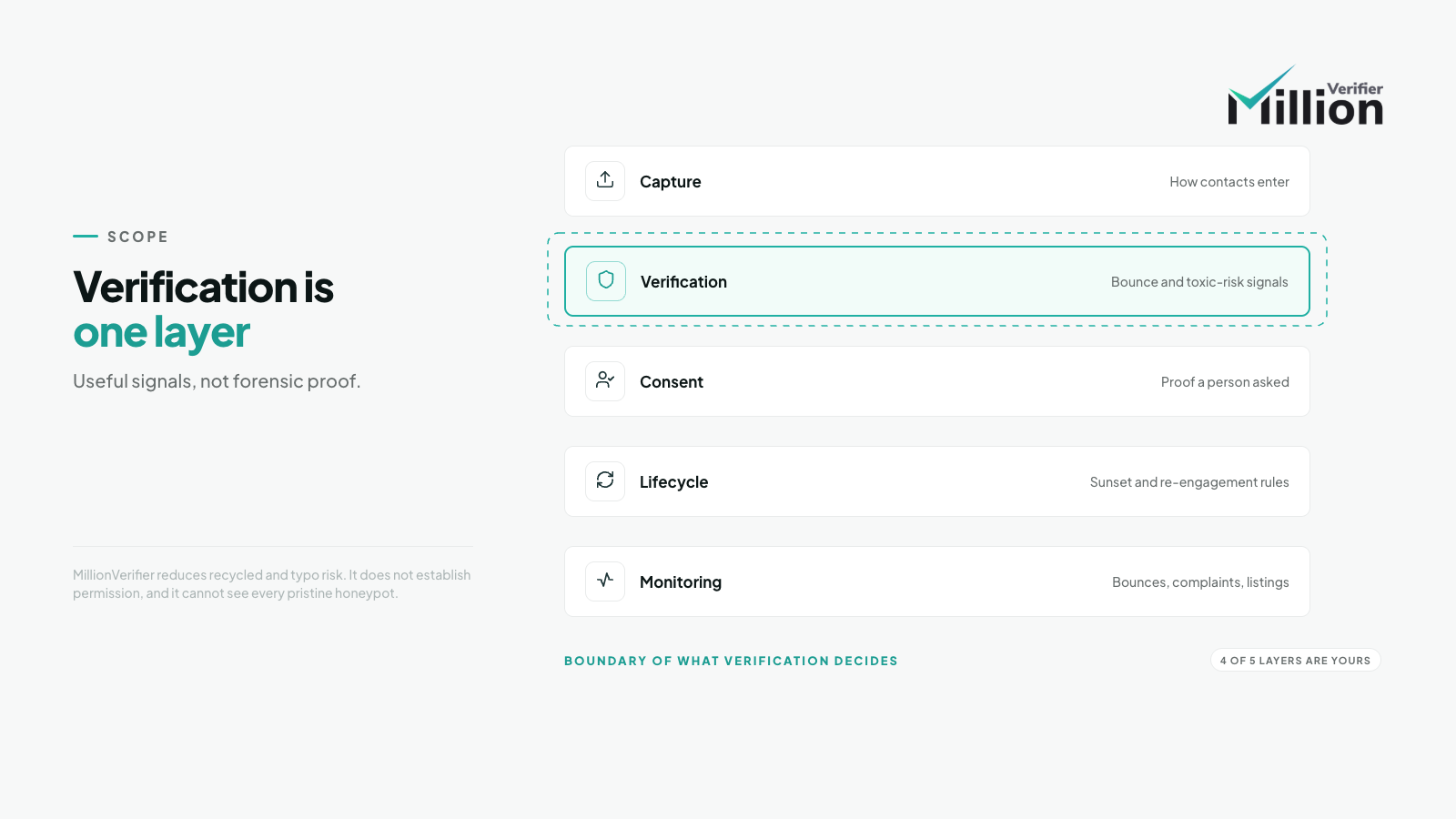
- MillionVerifier has a defined scope: it removes undeliverable and disposable addresses and flags risky ones, which shrinks the pool of records where recycled and typo traps hide, but it does not detect spam traps of any type.
- The durable prevention controls are operational: reject scraped lists, enforce double opt-in, and sunset unengaged subscribers after a window matched to your sending frequency.
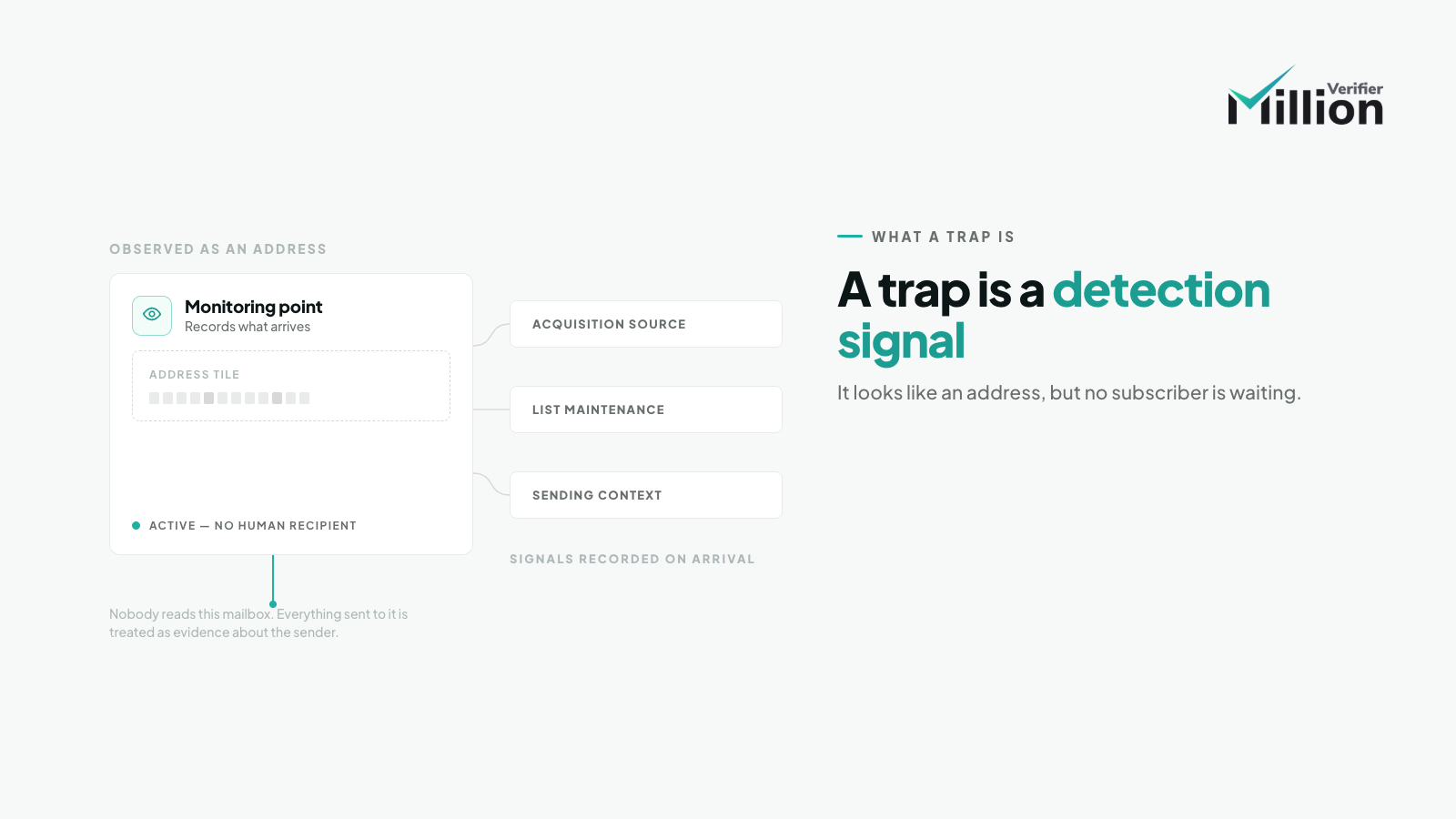
Spam traps look like email addresses, but they exist to detect poor list acquisition and maintenance. A hit can damage your sender reputation, push campaigns toward the spam folder, or contribute to a blocklist listing.
The uncomfortable part is that verification has a hard technical limit. A pristine trap can behave like a real inbox and return Valid during an SMTP check. No verifier can honestly promise to remove every one — trap operators never publish their addresses, and Spamhaus states plainly that it does not share its trap feeds with any third parties. MillionVerifier can remove addresses that no longer accept mail and flag risky ones, but it cannot repair missing consent or identify a honeypot.
That leaves three practical defenses: never use scraped lists, enforce double opt-in, and sunset subscribers once they stop engaging.
What Is a Spam Trap, and Does One Hit Really Get You Blacklisted?
A spam trap is an email address that mailbox providers, blocklist operators, and anti-abuse organizations use to spot careless list acquisition and maintenance. No person is waiting to read the campaign. Instead, the address reveals senders that contact recipients who never subscribed, abandoned an inbox, or entered an address with an obvious error. Spamhaus defines them simply as addresses "which have not opted into any email," and notes that their owners never reveal them.
One trap hit can attract disproportionate scrutiny. The outcome depends on the trap type, provider, sending volume, and sender history. A listing is not always instant, and different datasets work differently: Spamhaus's SBL is maintained by investigators, while its Combined Spam Sources (CSS) set is automatically produced from "multiple events and heuristics" — 300,000 to 400,000 new listings every 24 hours — so the same behavior can produce a manual listing on one dataset and an automatic one on another.
What happens if I email a spam trap?
The address may accept the message as if nothing is wrong. Behind the scenes, its operator can record your domain, IP, authentication signals, and campaign context. Those signals may contribute to throttling, spam-folder placement, reputation damage, or a blocklist listing.
One delivery does not guarantee an instant listing. Still, treat a suspected hit seriously: stop the affected stream, suppress the address, and trace how it reached your database.
Why did my domain get listed on Spamhaus?
A Spamhaus listing does not point to one universal cause. It may involve trap hits, unsolicited traffic, compromised accounts, malware, or wider infrastructure and reputation problems. Start with the exact record and its delisting guidance. Then audit your acquisition sources, consent evidence, bounce and complaint trends, authentication, and recent sending changes. List cleaning may be part of the response, but it will not explain every listing — and Spamhaus is blunt that it "frequently sees mail in its spamtraps from 'cleaned' lists."
Work through these questions:
- Which asset is listed? Use the IP and Domain Reputation Checker at check.spamhaus.org to confirm whether the record is tied to your domain, IP address, or another sending component, and which dataset holds it — SBL, CSS, XBL or PBL for IP addresses, DBL for domains. The record type determines the remediation path.
- When did the problem begin? Compare the listing or reputation change with imports, forms, vendors, and campaign launches.
- Can you identify the recipient source? Trace suspicious addresses to a list upload, web form, integration, or legacy segment.
- Are hard bounces or complaints rising? These patterns can expose stale or improperly acquired data even when no trap is confirmed.
- Did the operator provide a specific record or reason? Follow that evidence instead of guessing.
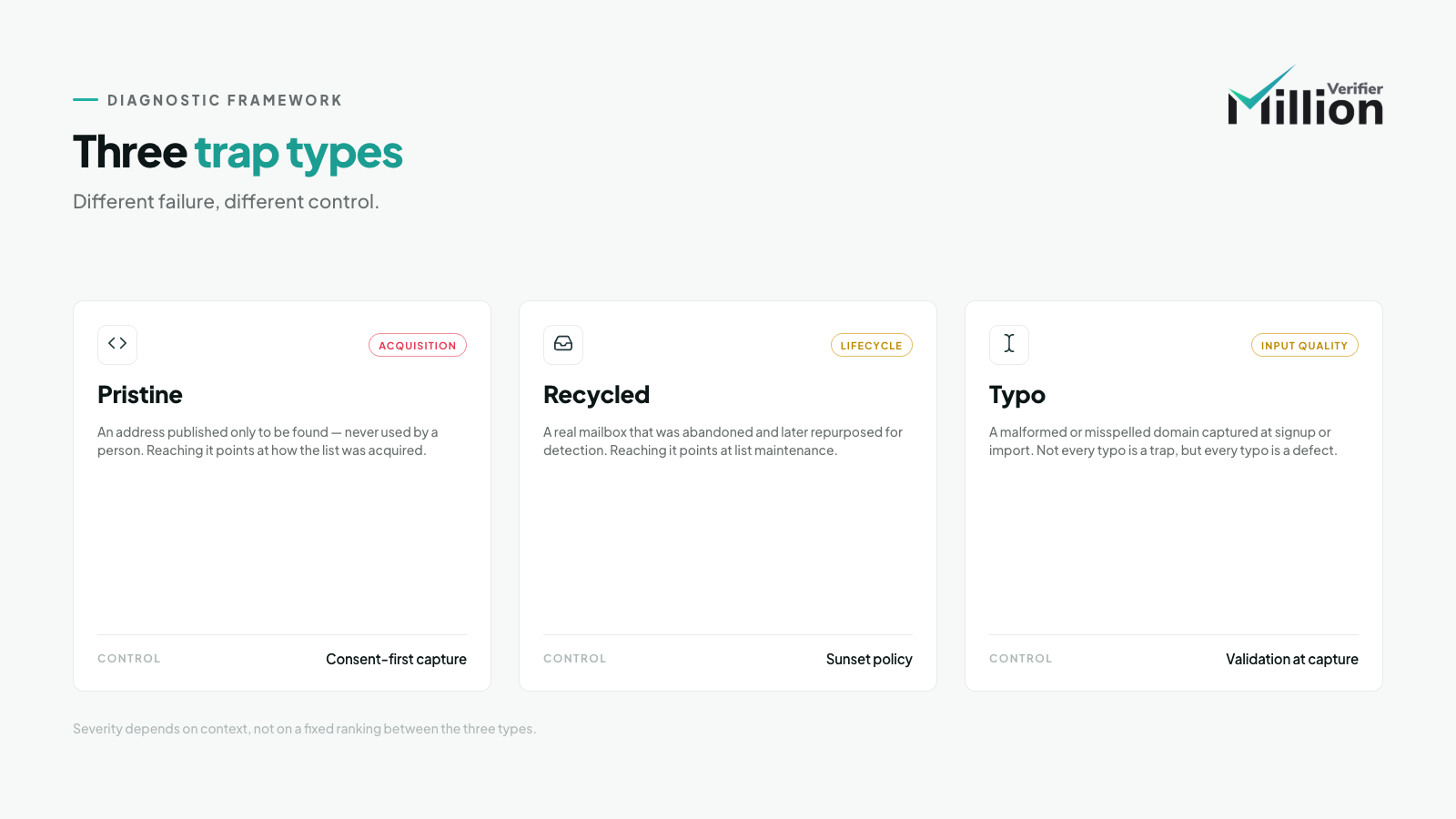
What Are the Three Types of Spam Traps: Pristine, Recycled, and Typo?
Pristine, recycled, and typo traps come from different failures, so one control cannot address them all. Use this table as a diagnostic framework, not as proof that a particular address is a trap.
Can Email Verification Remove 100% of Pristine Spam Traps?
No. A pristine trap is a working inbox, so an SMTP verifier may correctly report it as deliverable. In a deep SMTP check, the receiving server can complete the handshake and confirm that the mailbox exists. The result may be Valid even though no person requested your messages and the inbox is being monitored as a honeypot.
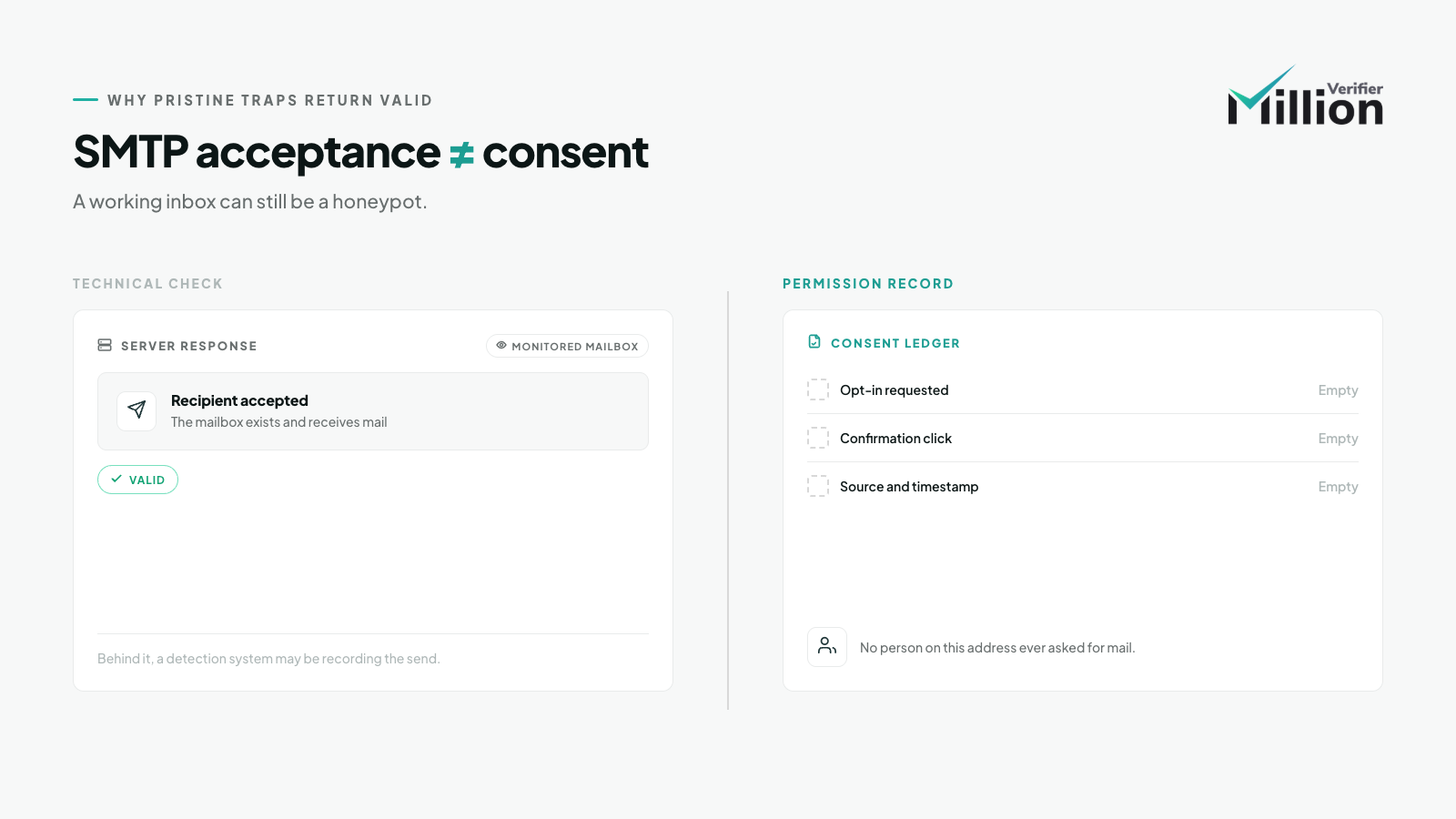
This is the line between deliverability and permission:
- SMTP can tell you, roughly, "This server will accept mail for this address."
- It cannot tell you, "A real person asked to receive these messages."
- It therefore cannot reliably expose a valid-looking pristine trap.
The same limit applies to a live recycled trap. Once a provider reactivates a long-dormant mailbox, it accepts mail again — that is the point of reactivating it — so it verifies as Ok exactly like a pristine trap. Verification catches such an address only during the period when it is still hard-bouncing.
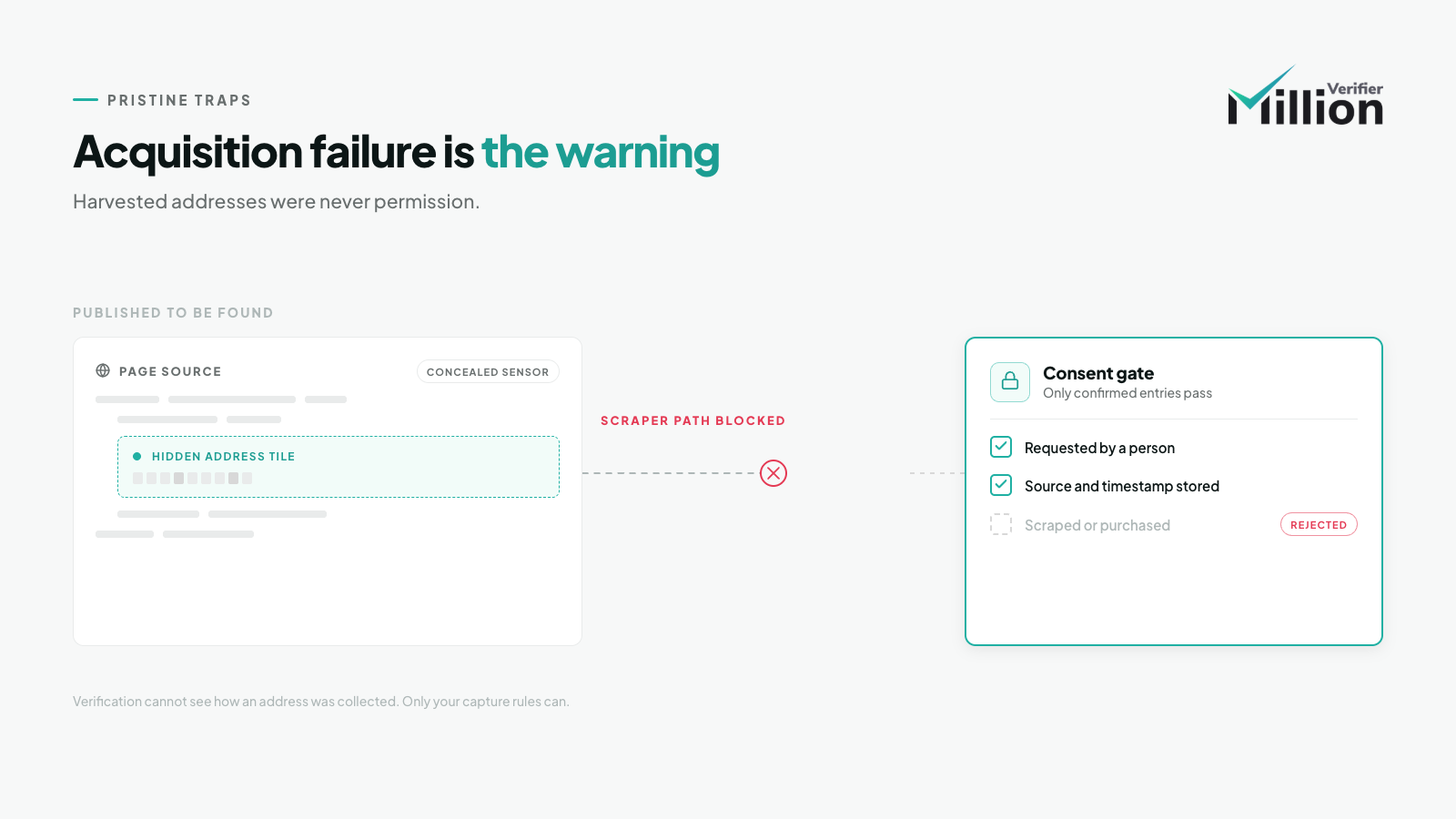
Any promise of "100% spam trap removal" is misleading. Marking every working mailbox as invalid would also remove legitimate subscribers. The reliable defense happens before verification: acquire addresses transparently, record consent, protect forms from bots, retain source and timestamp evidence, and remove data that no longer shows healthy engagement.
What Can MillionVerifier Actually Do About Recycled and Typo Risk?
MillionVerifier does not detect spam traps, and no verifier honestly can — ISPs and blocklist operators never publish, share, or leak their trap addresses. What verification does is shrink the population of records where recycled and typo traps are found: it removes addresses that no longer accept mail, flags catch-all and unknown domains as risky, and catches malformed or misspelled addresses at the point of capture. It cannot replace permission controls or guarantee protection from a pristine trap. Verification works best as one layer of a wider deliverability program. For the rest of that program, see [The Ultimate Guide to Email Deliverability & Sender Reputation](INTERNAL LINK — add URL before publishing).
Results are grouped as Good (Ok), Bad (Invalid, Disposable), and Risky (Catch-All, Unknown), with free and role flags available through the API. There is no trap-detection status, and there is no honest way to add one.
What can MillionVerifier do about recycled-trap risk?
Verification can flag Invalid results and other risk signals while a dormant mailbox is still bouncing, which is the only window in which a verifier can see it at all. Run these checks on legacy lists, re-engagement audiences, and imports before you send. The results indicate risk; they are not forensic proof, and a mailbox that has already been reactivated as a trap will return Ok. Review them alongside consent, source, bounce history, and the age of the recipient's last engagement.
To manage lifecycle health effectively, establish a routine list-cleaning schedule rather than waiting for bounce rates to spike. By regularly running your CRM and marketing lists through the MillionVerifier Bulk Email Verifier, you can proactively identify and remove bad or risky addresses. For the remaining hard-to-verify addresses, the Catch-All Email Verifier gives you a definitive decision on the risky bucket instead of a coin flip.
How can MillionVerifier help with typo traps?
Syntax and domain analysis can catch malformed addresses and suspicious spellings. A misspelling such as gmial.com usually has no mail server at all and comes back Invalid, while other typo domains — misspellings of the large consumer providers, for example — do publish mail servers and accept whatever arrives. MillionVerifier's real-time API can reject or quarantine both kinds at signup, while batch verification checks records already in your database. This keeps obvious entry errors from becoming bounces or polluting segments. It does not prove that the owner gave permission.
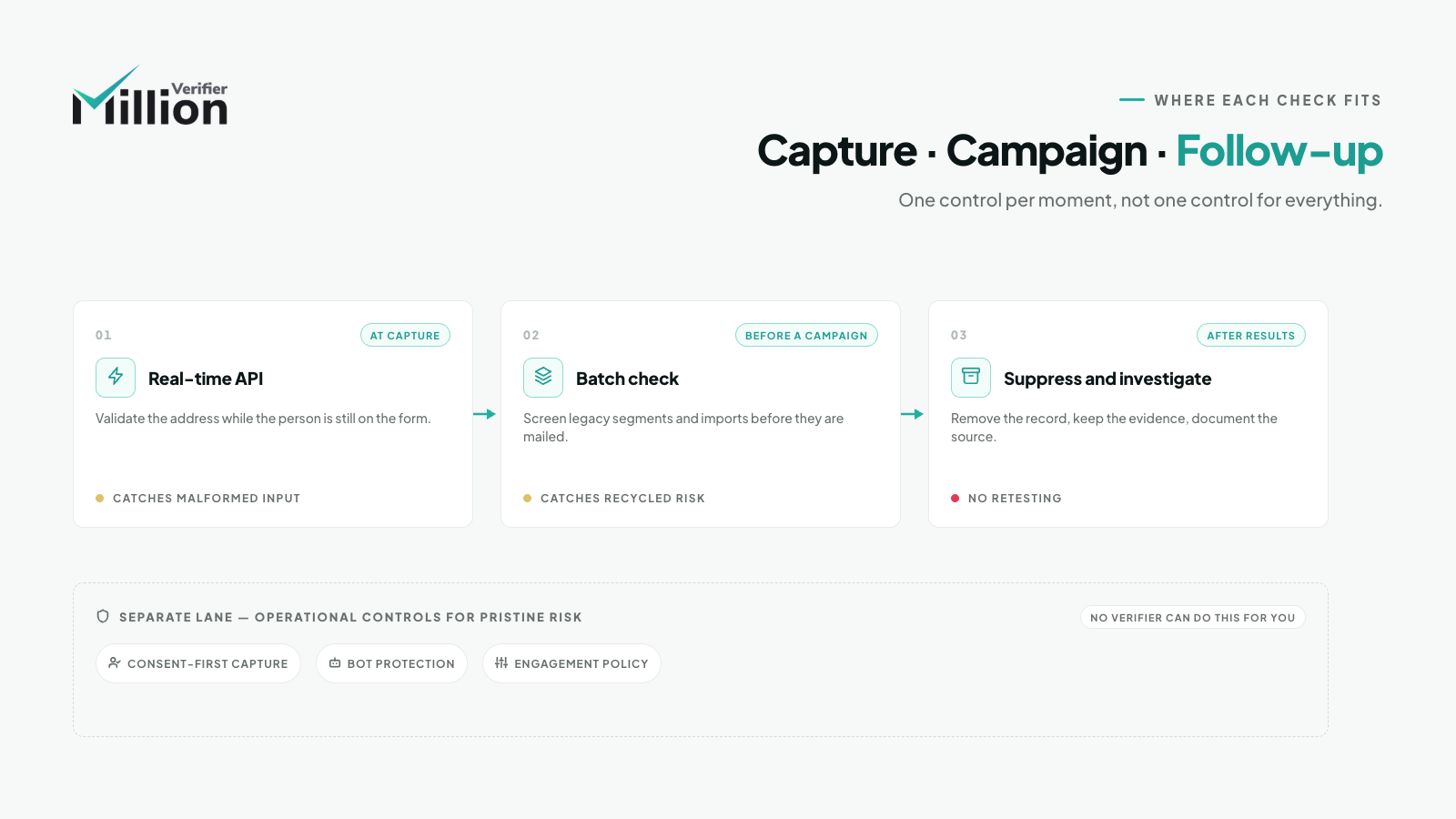
Use each check where it fits:
- At capture: call the real-time API to block or quarantine malformed addresses before CRM insertion.
- Before campaigns: batch-check new imports and risky legacy cohorts.
- After results: suppress risky records, investigate their source, and document decisions.
- For pristine risk: rely on acquisition, consent, bot protection, and engagement policy; do not represent verification as a complete solution.
What Three-Step Workflow Keeps Spam Traps Out of Your List Without Software?
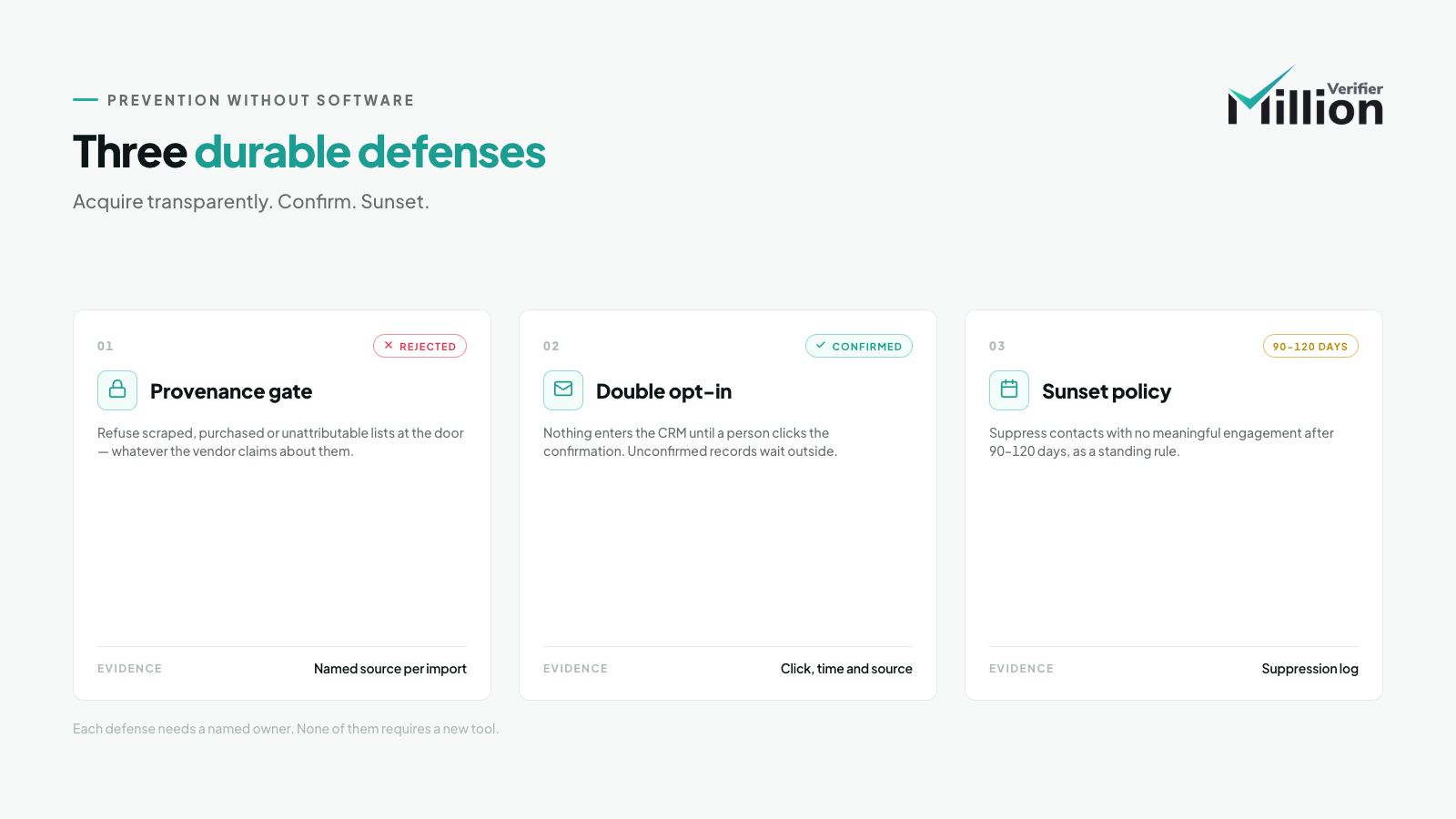
Use this operational workflow to keep pristine traps out of your CRM and reduce exposure to recycled and typo traps. It does not depend on verification software. Give each step a clear owner and keep the supporting evidence.
- Never buy scraped lists. Scrapers collect hidden pristine traps from website source code along with addresses whose owners never gave permission. Reject purchased, harvested, and supposedly "opt-in" lists when their provenance cannot be verified — as Spamhaus puts it, "no legitimate company will ever sell or rent a list of 'confirmed-opt-in' email addresses," because permission is not transferable. Build your audience through transparent forms, clear consent language, and source-level records.
- Enforce double opt-in (DOI) alongside bot defenses. Do not activate a subscriber until the recipient clicks the confirmation link. Note what this does and does not buy you: the confirmation request is itself a message to the address, so a scraped pristine trap in a DOI flow still receives one email. DOI caps your exposure at a single confirmation attempt instead of an ongoing campaign stream. Most bots cannot complete the click, but not all — automated link scanners follow links in email, and subscription-bombing attacks are built to push addresses through forms — so rate limits, CAPTCHA or honeypot fields, and retained timestamp, source and consent evidence carry as much weight as the click itself. Under GDPR-style rules that evidence is also what makes consent demonstrable: who confirmed, when, from where, and what wording they saw.
- Implement an unengaged sunset policy. Set the window against your sending frequency — roughly 90–120 days for a weekly program, longer where the natural buying, renewal, or seasonal cycle is longer — and apply it consistently. Judge engagement on clicks, replies, purchases, and site or app activity first; Apple Mail Privacy Protection preloads tracking pixels whether or not a message was read, so opens are inflated by default and belong in a weak secondary role. Use a measured re-engagement sequence where appropriate, then suppress nonresponders automatically. This reduces repeated mail to an inbox that its owner has abandoned and that may later be reactivated as a recycled trap.
What Pitfalls and Edge Cases Should You Troubleshoot?
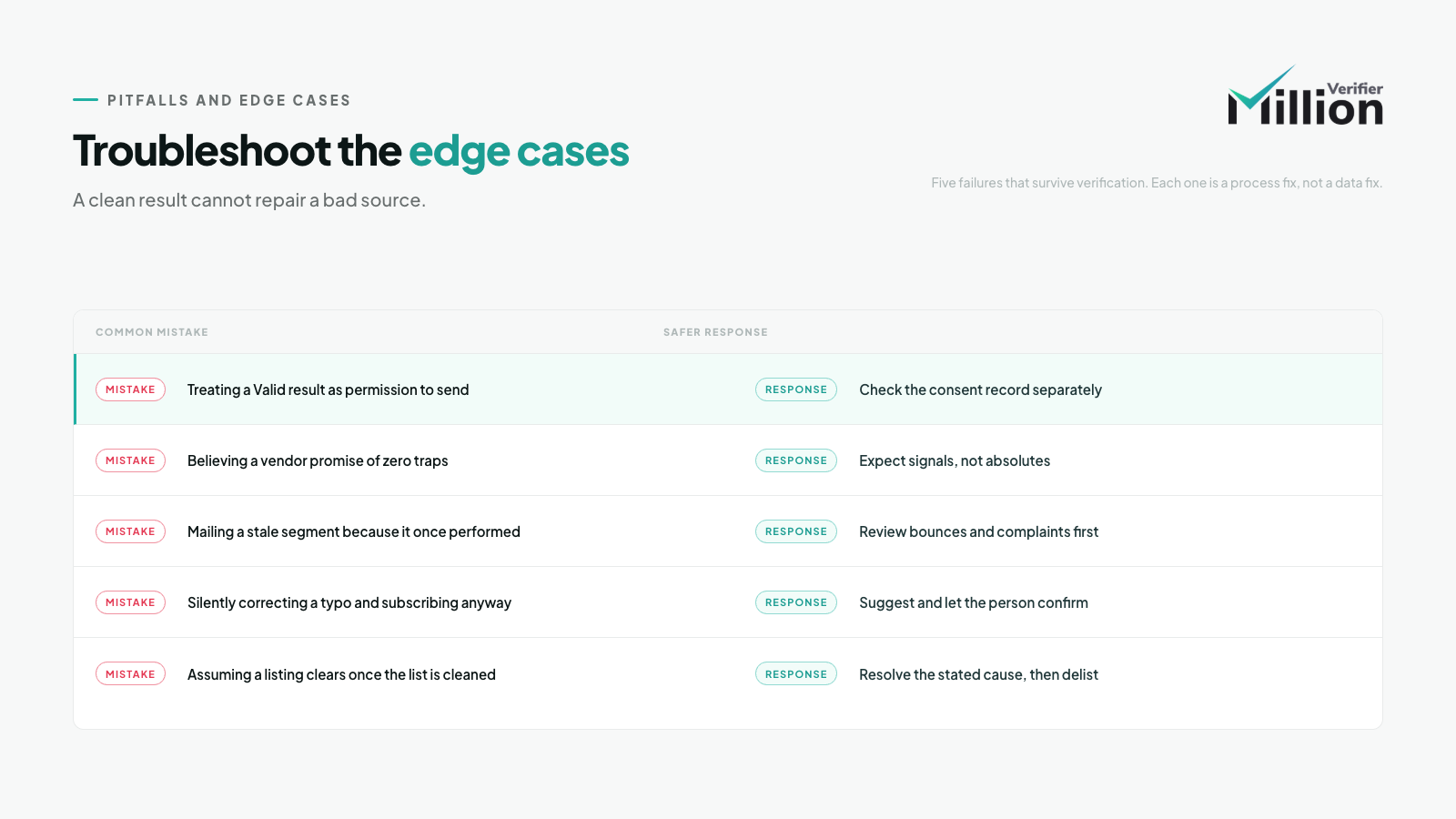
A clean verification result cannot repair a bad acquisition source, and a trap signal will not explain its own cause. Check these common failure points before and after remediation.
Do not "test" a suspected trap by sending to it again. Suppress the address, preserve it for investigation, and trace its source. Read patterns in context, too. A recycled-trap signal may expose a lifecycle failure, while a cluster of typos may point to a broken form or integration rather than malicious subscribers.
What Is the Practical Takeaway for Email Marketers?
Spam-trap prevention starts with acquisition and lifecycle discipline, not verification alone. MillionVerifier can remove undeliverable, disposable, and malformed addresses during import and capture, which shrinks the pool where recycled and typo traps hide — but it does not detect traps, and it cannot make a live honeypot look invalid. The durable approach combines consent-first acquisition, DOI, source traceability, targeted verification, and timely suppression of unengaged records.
Frequently Asked Questions
Can a pristine spam trap return Valid in an email verification check?
Yes. A pristine trap is designed to function like a real mailbox, so its server may complete an SMTP handshake and return a Valid-style result. That status describes server acceptance, not consent or human ownership. No verifier can promise pristine-trap detection without risking false positives against legitimate subscribers.
Does MillionVerifier guarantee that my domain will never hit a spam trap?
No. MillionVerifier removes undeliverable and disposable addresses and flags risky ones through batch checks and its real-time API, but it does not detect spam traps: a live trap accepts mail and verifies like a legitimate inbox. Pair verification with DOI, source controls, bot defenses, and a sunset policy to reduce risk; no responsible provider can eliminate it entirely.
Why might a Spamhaus listing remain after I verify my email list?
It depends on the listing record and its cause. Verification may reduce risky recipients, but it cannot undo unsolicited acquisition, compromised infrastructure, malware, complaint patterns, or a prior trap hit. Inspect the exact Spamhaus record, stop the offending stream, secure sending systems, document remediation, and follow the operator's delisting process — with Spamhaus, the only route off a list is fixing the problem that caused it, and removal is never charged for.
How does double opt-in protect a list from pristine traps?
DOI requires the recipient to click a confirmation link before activation, so an address that never consented receives one confirmation request rather than a campaign stream. Most scraped or bot-submitted addresses never complete that step, though automated link scanners sometimes do. Store the consent timestamp and source, add rate limits and bot protection, and suppress unconfirmed records. DOI protects acquisition; it does not replace bounce and complaint monitoring.
Should I keep sending to an old subscriber who still passes SMTP verification?
No. SMTP acceptance does not demonstrate current engagement, permission, or safety from recycled-trap risk — and a mailbox that has already been reactivated as a trap will pass verification. Apply your sunset window, offer measured re-engagement where appropriate, then suppress nonresponders. MillionVerifier may add useful risk signals, but lifecycle decisions should also use consent evidence, source provenance, and observed engagement.
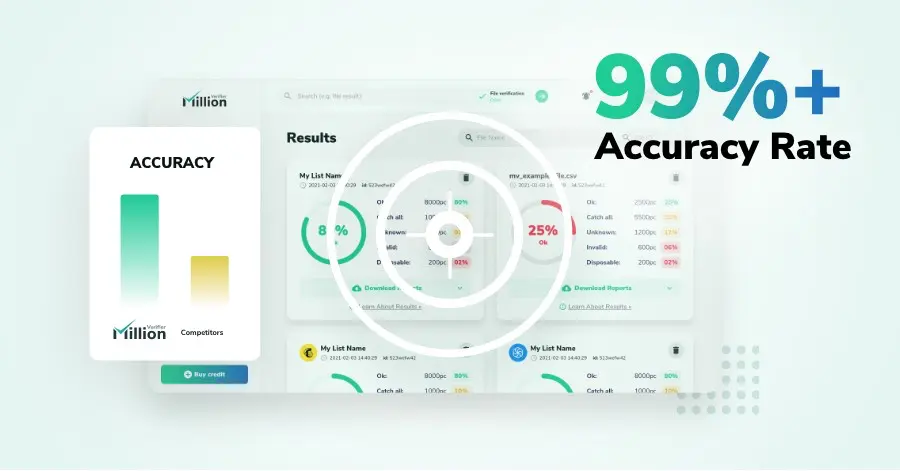
We have kept improving our email verification software for over six years now, and we are incredibly proud of our outstanding 99%+ email verification accuracy.
We have created MillionVerifier to provide the best email verification service possible for email marketers with higher email verification needs.

Our customers love what we do. We work hard to deliver the best results and user experience for our customers.